
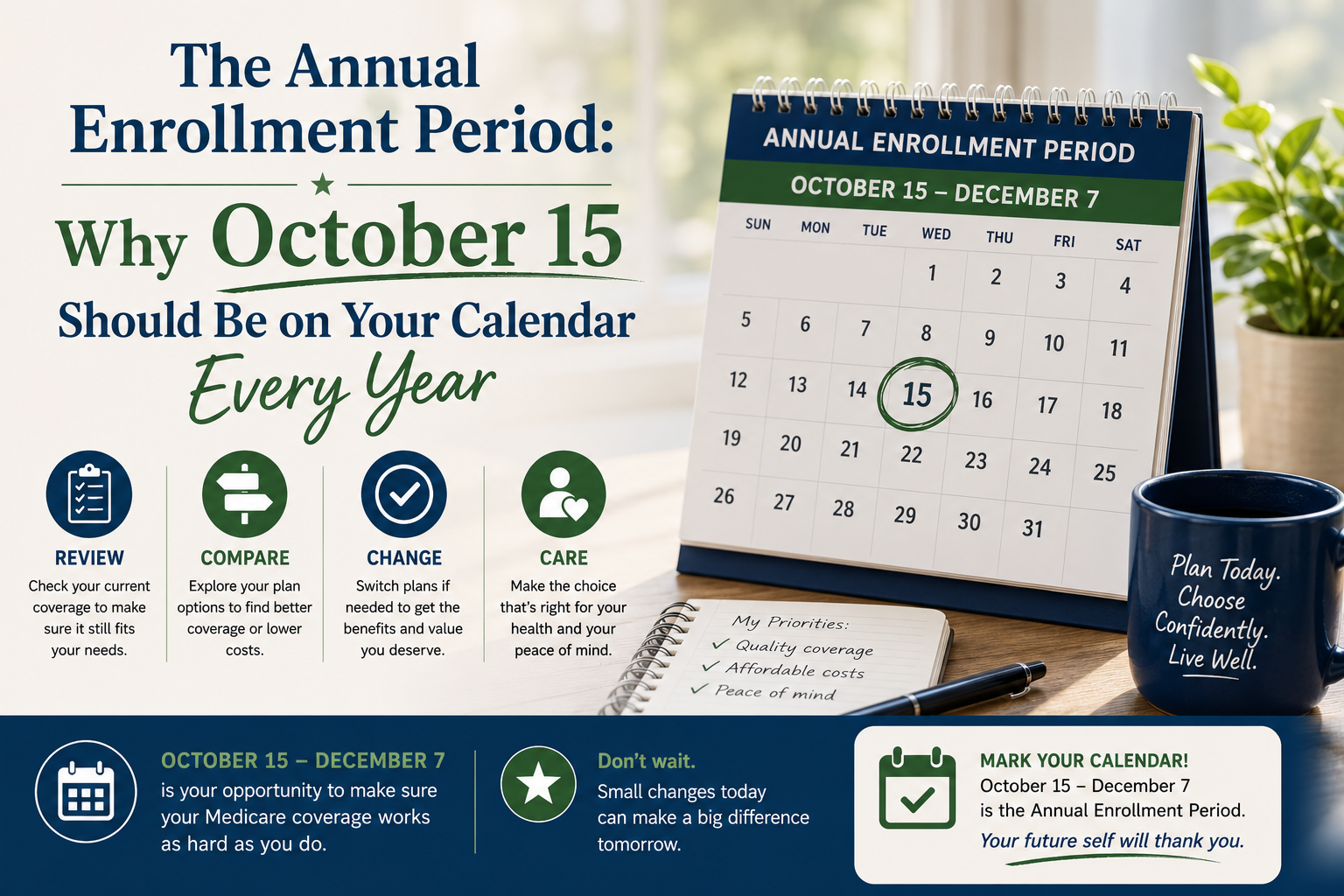
The Annual Enrollment Period: Why October 15 Should Be on Your Calendar Every Year
Most people enroll in Medicare, choose a plan, and move on. They have other things to think about, other places to put their energy, and a life to live. The idea of revisiting Medicare every year can feel like an unnecessary task.
Here is the reality: Medicare plans change every year. Premiums shift. Formularies change. Provider networks expand and contract. A plan that was exactly right for you last October may be quietly working against you by next January, and you may not know it until you are already paying more than you should.
The Annual Enrollment Period, which runs from October 15 through December 7 every year, is your opportunity to fix that. It is one of the most important dates on the Medicare calendar, and treating it as a routine annual check rather than an afterthought is one of the most valuable things you can do for yourself.
What the Annual Enrollment Period Allows You to Do
During the Annual Enrollment Period, people already enrolled in Medicare can make the following changes, with all changes taking effect on January 1 of the following year.
You can switch from one Medicare Advantage plan to another. You can switch from Medicare Advantage back to Original Medicare. You can join a Part D prescription drug plan if you do not currently have one. You can switch from one Part D plan to another. And you can drop a Part D plan entirely if you have other creditable drug coverage.
What you cannot do during the Annual Enrollment Period is enroll in a Medigap plan with guaranteed issue rights. Medigap enrollment has its own separate rules and windows. If you are considering adding or changing a Medigap plan, contact us separately to understand your options.
Why Your Plan From Last Year May Not Be Your Best Option This Year
Medicare Advantage and Part D plans are required to notify you of changes to your coverage before October 1 each year through a document called the Annual Notice of Change. If you receive one of these letters, read it. Do not set it aside.
Plans can change their premiums, their deductibles, their copayment structures, their provider networks, and their drug formularies from one year to the next. A medication you take regularly may move to a higher cost tier. A specialist you rely on may leave the network. Your monthly premium may increase in ways that are not immediately obvious until you look closely.
None of these changes require your approval. They happen automatically unless you act during the Annual Enrollment Period. The plan you are on at the end of December is the plan you will have in January.
The Real Cost of Not Reviewing
People who do not review their coverage annually often discover the cost of that decision at the worst possible time. When they go to fill a prescription and find it is no longer covered at the same tier. When they need a specialist and find their referral process has changed. When they compare notes with a friend and realize they are paying significantly more for equivalent coverage.
These are not catastrophic situations in most cases. But they are unnecessary ones. The Annual Enrollment Period exists precisely to prevent them, and using it well costs nothing except an hour of your time.
That hour can mean real savings. It can mean keeping the doctors you want. It can mean a Part D plan that actually covers the medications you take at a cost that makes sense. Small adjustments made annually add up to significant differences over time.
What a Good Annual Review Looks Like
A thorough annual Medicare review covers several things. Your current plan’s changes for the coming year, based on the Annual Notice of Change. Your current medications and whether your plan’s formulary still covers them at a reasonable cost. Your current providers and whether they remain in your plan’s network. Whether your health needs or financial situation have changed in ways that affect which type of coverage makes the most sense.
It also covers whether better options have become available in your area. Plan offerings change year to year. A plan that did not exist or was not competitive last year may be exactly what you need this year.
This is the review we conduct with every Meridian 65 client ahead of the Annual Enrollment Period. We look at your full picture, compare your current plan against what is available, and give you a straight answer about whether staying put or making a change makes more sense for you.
A Note on the Medicare Advantage Open Enrollment Period
If you miss the Annual Enrollment Period or realize after January 1 that your Medicare Advantage plan is not working for you, there is a limited additional window. The Medicare Advantage Open Enrollment Period runs from January 1 through March 31 each year. During this window, people already enrolled in a Medicare Advantage plan can switch to a different Medicare Advantage plan or return to Original Medicare once. Changes take effect the first day of the following month.
This window is narrower and offers fewer options than the Annual Enrollment Period. It is a safety valve, not a substitute for reviewing your coverage in the fall.
Put It on Your Calendar Now
October 15. Every year. That is the date the Annual Enrollment Period opens, and it is the date your review should begin.
The people who get the most out of Medicare are not necessarily the ones who chose perfectly the first time. They are the ones who treat their coverage as something worth maintaining, reviewing, and adjusting as their lives evolve.
You have built a life worth protecting. Your Medicare coverage should keep up with it.
Want someone in your corner for your annual review?
Meridian 65 conducts annual plan reviews with every client ahead of the Annual Enrollment Period. Schedule a consultation and we will make sure your coverage still fits your life.